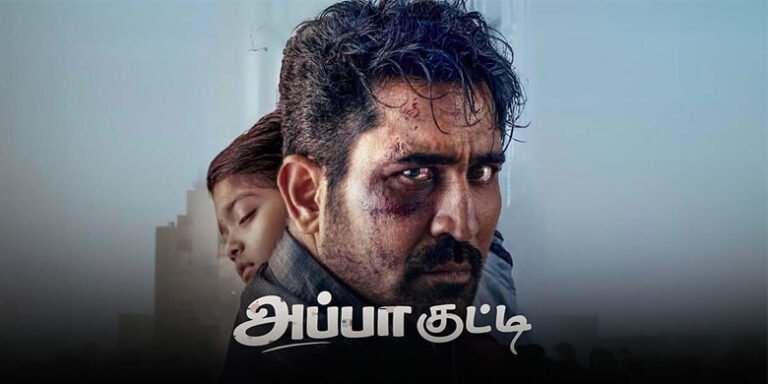
APPA KUTTY Tamil Movie Review
Cast-:
Vijay Antony, Preethi Asrani, Bhagavathi Perumal, Vettai Muthukumar, Aruvi Mathan, Jenson Diwakar, Muruganantham, Sreeja Ravi, Praveena, Chitra Laxmanan, Hari Priya Isai, Hari Priya, Kumar Natarajan, Swamynathan, Baby Lithanya , Lissy Antony , Tha. Muruganantham , Munnar Ramesh , Nevedhitha PK , Agathiyan, Cobra,Pradeepkumar, Ashok Samrat,Sri Devi , Lithanya Sivabalan Sanchana Natarajan, I.M. Vijayan and Others.

Crew–:
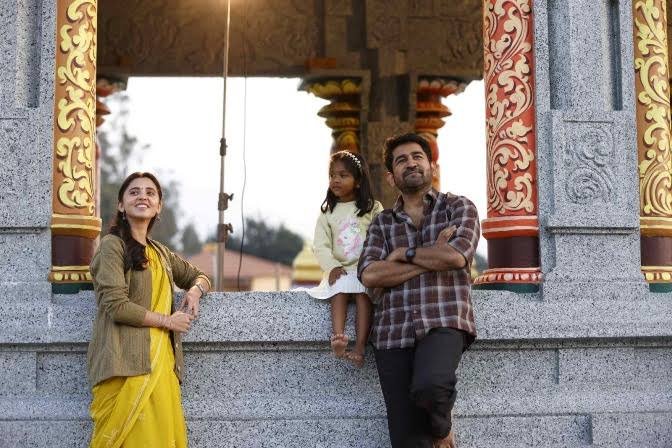
Writer & Director: MU.Maran , DOP: Rajeev Rajendran , Editor: Vijay Antony , Music: Vijay Antony , Additional Dialogues: Puthiya Parithi , Art Director: A.Raja , Stunt Master: Rajasekar , Lyricist: Ekadesi, Arun Bharathi , Costume Designer: Anusha Meenakshi , Costumer: M.Selvaraj Makeup: Sreeralan Mani , Sound Engineer: S Chandrasekhar , Sound Designer: Vijay Rathinam MPSE , Sound Mixing Engineer: A. M. Rahmatullah , DIT: Sakthivel , DI: Promo works , Colourist: Adithya Technical Head: Janarthanan , Executive Producer: D. Naveen Kumar , Production Executive: Annamalai Sami , Casting Director: Sugumar Shanmugam , Publicity Designer: Ramesh , Still Photographer: Mahesh Jayachandran , PRO: Rekha , Trailer Edit: Harish Yuvaraj, and Others.

Story -:
Films starring Vijay Antony often revolve around emotionally charged storylines. In this vein, *Appa Kutty* centers on the life of a man who becomes a devoted father figure to a child, while harboring a hidden past. The film is directed by Mu. Maran, known for his work on *Iravukku Aayiram Kangal* and *Kannai Nambathe*.
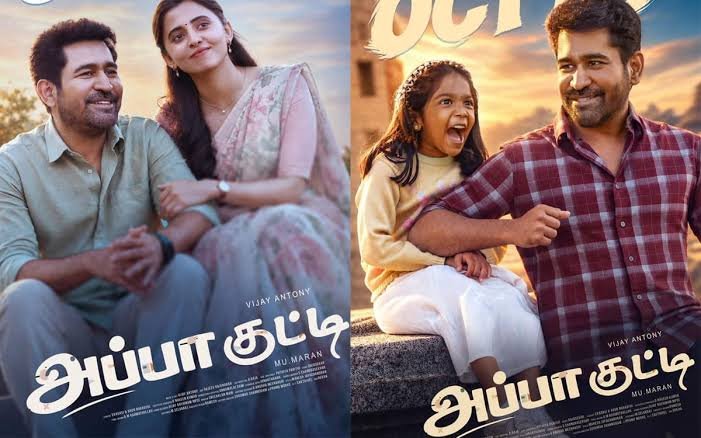
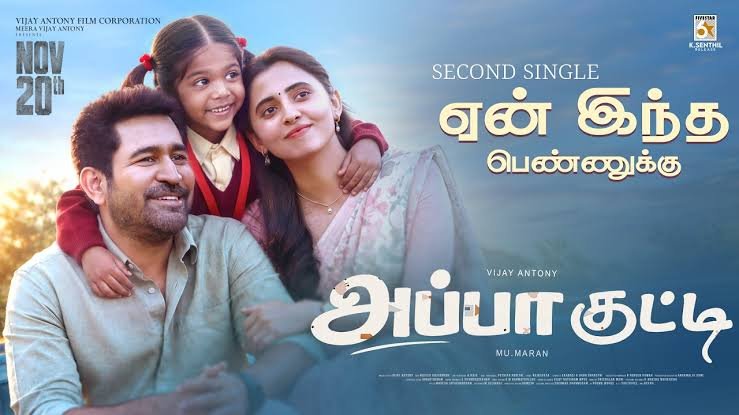
Vijay Antony arrives in Ooty with a child, whom he raises with great love and care. As the child grows, her school teacher, Preethi Asrani, develops feelings for Vijay Antony, moved by the deep affection he shows toward the child. However, Vijay Antony chooses to maintain only a friendship rather than pursuing a romance. The narrative takes a turn when the child faces a life-threatening health crisis—a situation that brings long-buried truths to light. What are these secrets, and does he succeed in saving the child? The rest of the film unfolds to reveal the answers.
Watch The Video -;
Movie Review -:
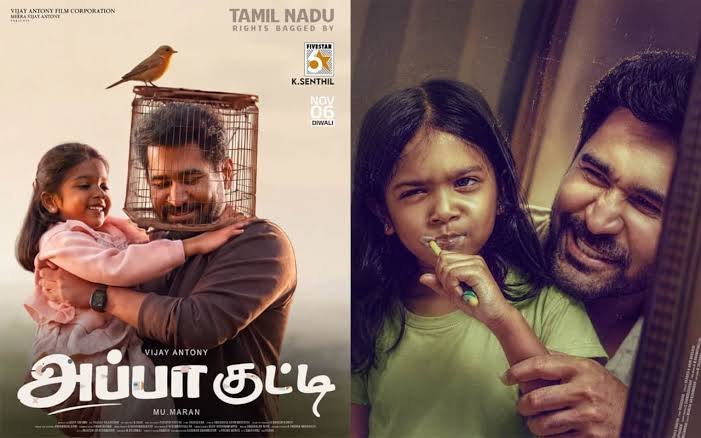
In Koyambedu, Chennai, Surya (Vijay Antony)—carrying a child—is attacked by a gang of thugs. After overpowering them, he boards a bus and eventually arrives in Ooty. There, he works as a local manager for film shoots, raising the child—whom he names Diya (played by little Lithanya)—and enrolling her in school.
Since his wife has passed away, Surya takes on the roles of both father and mother to his daughter. Anita (Preethi Asrani), Diya’s school teacher, observes this and wishes to marry Surya, hoping to become a mother to Diya. However, Surya is not interested.
At Diya’s request, Anita creates a large portrait of the girl’s late mother. Just as Surya begins to develop feelings for Anita, she happens to encounter Revathi (Haripriya)—the woman believed to be Diya’s deceased mother—in person.
When Anita questions Surya about this, he insists that Revathi is not Diya’s mother.
Surya then explains the past: He and Revathi were in love, but her parents disapproved and arranged for her to marry a relative. During a critical moment—while he was trying to save his beloved—Surya also attempted to rescue a child from a gang that exploits children for begging (a sequence featuring a boy selling snacks on the beach is particularly striking).
The police, however, were complicit with the gang. A police officer connected to Revathi’s family intervened, detaining Surya at the station, which allowed Revathi’s marriage to another man to proceed.
Surya recounts all of this to Anita.
Meanwhile, Diya suddenly falls ill and collapses. The doctor states that the child is suffering from Thalassemia and that she can only be saved if stem cells from a biological sibling are transplanted into her body.
Anita suggests that they could consider the next steps if they identify the child’s biological mother—at which point, Surya reveals, “I am not Diya’s father either.”
Anita learns that Diya is the very same child Surya had rescued from a criminal gang—a rescue that cost him his relationship with Revathi.
Now, to save Diya, her biological parents must be found. This forces Surya to return to the very same group of criminals from whom he had originally rescued the child—the same people who had once exploited her by forcing her to beg.
The question of what might happen to Surya at the hands of this ruthless gang provides enough material for a full-fledged commercial film…
But as the saying goes, “That was just the trailer, my dear—the main feature is yet to come.”
Who are her mother and father? Where are they now, and what are their current circumstances? Is it even possible for them to have another child? Who would agree to it, and who would refuse? Is there a chance for those who refuse to change their minds—or is there someone who might sabotage those who are willing to agree? Like this… and then like that…
Much like the branching, vivid streaks of lightning across the night sky, the screenplay unfolds by introducing a series of new characters and subplots.
Director M. Maran crafts a gripping and weighty narrative that explores the lengths to which Surya—a devoted father—must go to save his daughter, Diya. The film delves into the consequences these actions have on the lives of others, ultimately revealing whether or not Surya succeeds in his mission to rescue his child.
The film is inspired by the true story of a young girl from Pune who recovered from Thalassemia.
In a sense, this film could be considered another *Pichaikkaran* (Beggar) for Vijay Antony.
Much like *Pichaikkaran*, this film features poignant, meaningful, and deeply moving songs, along with a climax that is sure to melt the audience’s hearts.
As in *Pichaikkaran*, Vijay Antony portrays a character who remains steadfast—an anchor—regardless of the circumstances, hardships, or dangers he faces. He delivers a composed and excellent performance, maintaining the consistent rhythm of his character’s nature right until the very end.
Director Maran takes his time in the first half to lay the groundwork for the film’s pivotal turning points—starting with an action sequence, followed by scenes in Ooty, the life of a father and his daughter, school days, and the deep bonds of affection. After the interval, however, he truly excels in both his writing and direction.
The film shines through its sharp writing and direction, capturing the various people Surya encounters, the challenges he faces, and the relentless, mounting obstacles that crash upon him like waves—or loom before him like mountains—as he fights to save his daughter. The progression of the screenplay is exceptional—from the scene where Suriya’s character gets beaten up by Aruvi Madhan, to the predicament he finds himself in while caught between Madhan and Hari Priya, to the point where he feels he has run out of options. His troubles stem from his desire to ensure that no one else gets into any trouble, and the final decision he makes brings it all together brilliantly.
A special highlight is how, amidst the intense sequences of the second half, bursts of comedy pop up unexpectedly, keeping the mood lively.
In the second half, the film’s screenplay—penned by Maran—and the editing by Vijay Antony work in brilliant tandem to weave the backstory into the narrative in a compelling way.
Beyond composing heart-melting songs, Vijay Antony also adds significant depth to the film through his background score.
Rajeev Rajendran’s cinematography excels, whether it is by capturing the scenic beauty of Ooty to provide a sense of relaxation or by skillfully framing the film’s emotionally charged moments.
Little Lithanya anchors the film wonderfully with her exceptional performance as a child. She truly shines—delivering long lines of dialogue with perfect modulation and natural ease, while her subtle, expressive gestures are absolutely captivating.
With her bright, ever-smiling lips and beautiful eyes, Preethi Asrani—who appears like an ordinary girl in long shots but takes on a special, striking quality in close-ups—truly embodies her character.
Muruganandam stands out in the comedic sequences.
Haripriya Isai delivers a fine performance in a complex role, while another Haripriya appears in a distinct, unique look.
Aruvi Madan, Bucks, and Kumar Natarajan also deliver excellent performances.
One might wonder why a man would choose to stand up for an orphaned child instead of rushing to save the woman he loves—but that is simply who his character is. It is a matter of empathy. Only a person like this could endure such immense hardships.
In the first half, many comedic lines appear as mere filler, serving no real purpose; they could have easily been removed. Doing so would have allowed the audience to approach the intense second half with a fresher perspective.
While protecting a child is a noble cause, one might question whether it was necessary to depict such extensive destruction and loss to achieve it—especially since the narrative ultimately leads to a climax that stays within the same predictable confines.
Certain events unfold without the knowledge of specific characters—or perhaps they remain unrevealed because those characters simply lack the capacity to grasp them. In the spirit of the idea that “even a lie can sometimes be shattered by the truth,” the film could have conveyed some of these moments with more subtlety—perhaps with the quiet, poetic grace of a classic.
Nevertheless, *Appa Kutty* stands out by eschewing the usual tropes—no array of weapons, guns, gore, grime, sweat, narcotics, or profanity. Instead, it elevates human emotions—love, affection, and sacrifice—while weaving in well-timed comedy. In short, *Appa Kutty* presents a truly divine father figure.
This Is My Personal Review So Please Go and Watch The Movie In Theatres Only.
Written by B4U Media Admin Ratting B4U Media Admin Ratting 4.5 / 5